> For the complete documentation index, see [llms.txt](https://xoul-ai-official-documentation.gitbook.io/xoul.ai-official-guide/llms.txt). Markdown versions of documentation pages are available by appending `.md` to page URLs; this page is available as [Markdown](https://xoul-ai-official-documentation.gitbook.io/xoul.ai-official-guide/navigation-and-information/moderation-overview/content-policies-in-detail.md).
# Content Policies in Detail
A detailed breakdown of the Content Policies for Xoul.AI.
## **Images**
All images used anywhere on the platform that are **Public** or **Unlisted** must follow the following rules:
### Images: Age
{% tabs %}
{% tab title="Depictions of Age" %}
**All character should look like they are at least 18.**
While all art styles are allowed, including photo-realistic, generic anime, cartoon style, and everything in between, make sure your character passably looks to be at least 18 years of age or older by avoiding:
* Small head to body ratio.
* Underdeveloped bodies (complete lack of hip/chest/etc. development) with small limbs.
* Extremely youthful faces with large eyes.
This applies to **all visible characters within an image**.
Ask yourself, does this depiction **believably represent a character which, on first glance, appears at LEAST 18 years of age?**
If the answer is no, or only when you click the image to reveal the non-cropped version, or requires the viewer read the text to be *convinced* they are looking at a character that is 18 or older, the character does not meet the threshold of an adult, and the image must be changed.
{% hint style="danger" %}
**Image Models are biased to create youthful looking characters; this is not an excuse!**
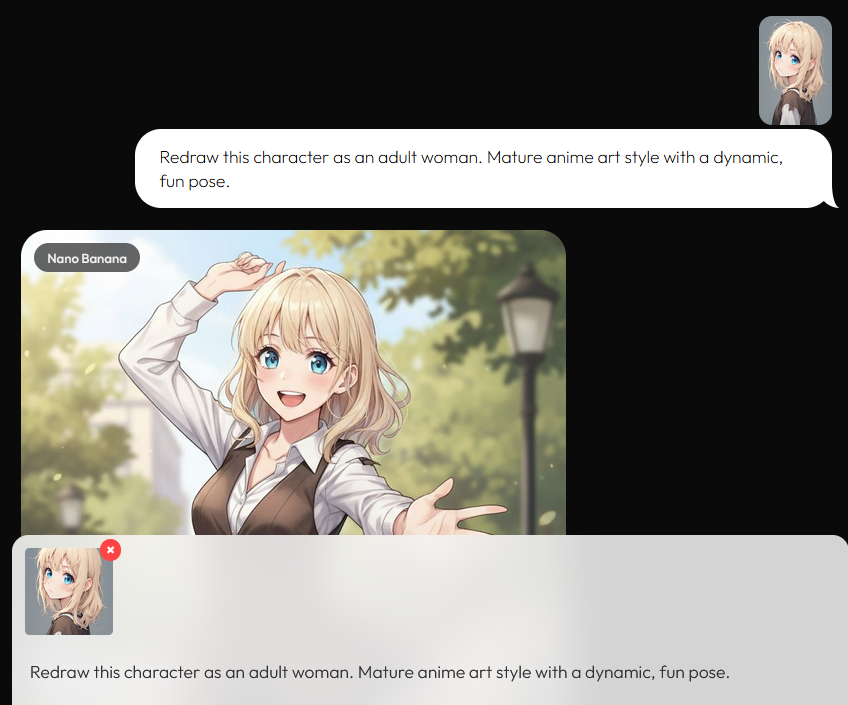
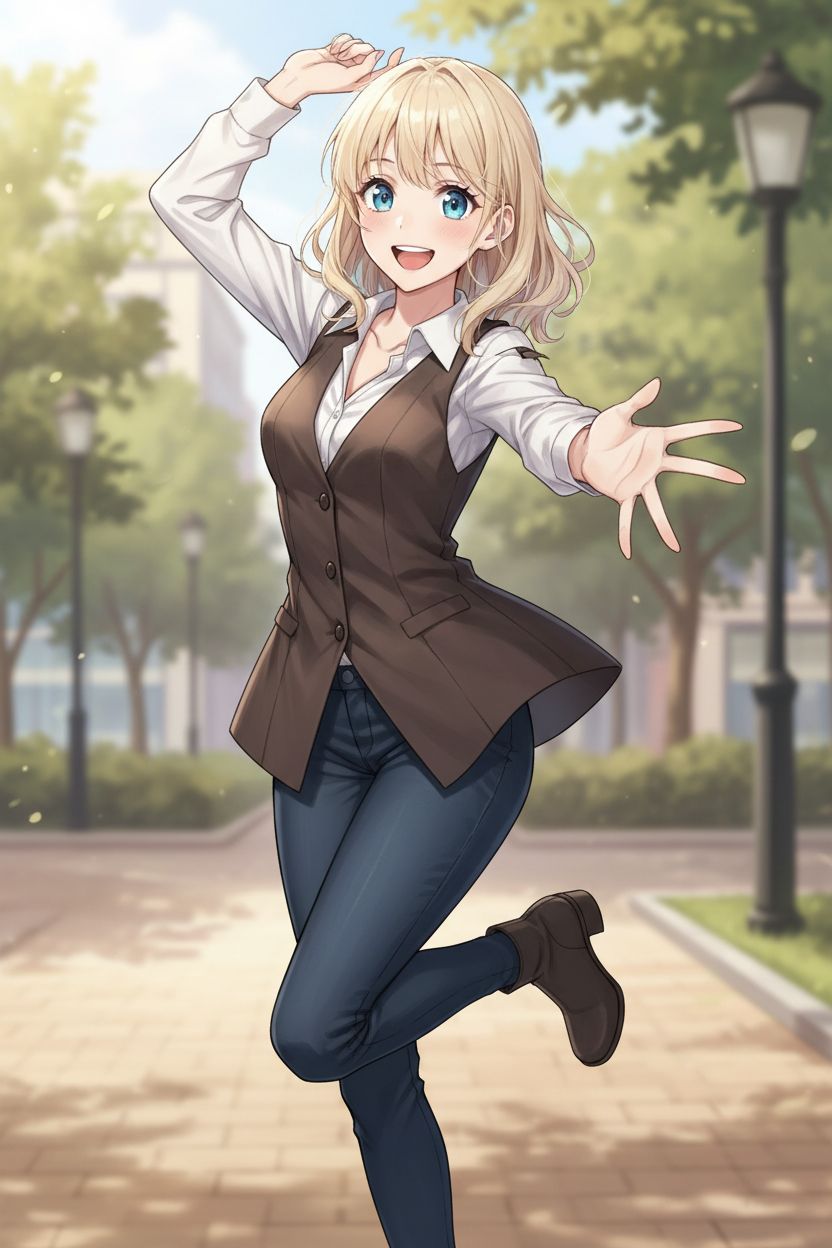
If you like the image run it back through an Image Model with a prompt for an adult portrayal. Nano Banana is great for this!
**Prompt**: `Redraw this character as an adult [man/woman]. Mature [anime, semi-realistic, realistic, etc.] art style.`
#### Example:

**Prompt**: `Redraw this character as an adult woman. Mature anime art style with a fun, dynamic pose.`
{% endhint %}
{% endtab %}
{% tab title="Tips for Age Appropriate" %}
**The Average Interpretation:** While characters can be flat chested, petite, short, etc. your character must still passably look to be 18 or older. If the *average person* would think your character looks like a young teen or child, it will be removed from public visibility.
**Canonical Characters:** Do not use depictions of canonical characters where they are clearly known to be a minor. The image must believably look to be at least 18.
**All Characters Pictured:** All characters visible in an image must look like adults, including characters in the backgrounds of images.
**Child Bodies:** A character with the body of a child (e.g. Loli or Shota characters) will never be approved for public display, regardless of technical age because these characters do not **believably look 18 years of age or older**
{% endtab %}
{% endtabs %}
### Images: Real People
{% tabs %}
{% tab title="Disallowed" %}
**Disallowed Images:**
* **Photos of real, living people from social media,** the internet, or that you took yourself without explicit consent.
* **Living (or recently deceased) celebrities or politicians,** in photos or as an AI-generated likeness.
* **Cropped images from someone's personal life** (e.g., taking a belly from a pregnancy vlog). Using personal images for fetish content is a serious violation and will not be tolerated.
**Remember:** Even if an image is cropped or edited, if it started as a real person without their consent, it's not allowed. The intent matters. Do not use images for fetishistic or harassing purposes.
{% endtab %}
{% tab title="Allowed" %}
**Allowed Images:**
* **Stock photos** you have the rights to.
* **People in costume** clearly portraying a fictional character.
* **AI-generated people** that are not based on a real person's *face or likeness*. Even drawings of celebrities are not permitted.
* **Illustrations and 3D models.**
{% endtab %}
{% tab title="Historical Figures" %}
**A Note on Historical Figures:**
Depictions of individuals who are considered historical figures (generally those who have been deceased for a significant period) are permitted. Please use good judgment and ensure the use is respectful.
{% endtab %}
{% endtabs %}
### Images: **Sensitive Content**
{% tabs %}
{% tab title="Coverage Rule" %}
**The Coverage Rule: No Nudity**
All characters must be appropriately clothed with opaque fabric.
{% endtab %}
{% endtabs %}
### Other Image Rules
{% tabs %}
{% tab title="Hate & Discrimination" %}
No images containing **hate symbols, discriminatory themes, or extremist iconography**. This includes stylized or ironic usage.
These include things like KKK robes, propaganda imagery, swastikas or other known hate symbols or icons.
{% endtab %}
{% tab title="Violence vs Gore" %}
**Violence & Gore Policy**
* **You CAN show:** Blood, injuries, and violent themes in a stylized or non-graphic context (e.g., zombies, fantasy fights). If it's what you'd see in a TV show or movie aimed at a general audience, it is permitted.
* **You CANNOT show:** Graphic gore, mutilation, or dismemberment. Avoid hyper-realistic, shocking, or excessive depictions of severe bodily harm.
{% endtab %}
{% tab title="Quality" %}
**Use high quality images that suit the content:**
* Avoid **low-quality**, **blurry**, or **incoherent** images.
* Images must **fit the content they represent** (e.g., don’t use random or irrelevant visuals).
* Do **not reuse the same image** for multiple Xouls, Scenarios, or other cards.
{% endtab %}
{% endtabs %}
## **Text & Concept Rules**
Text content includes all written or tagged elements on all content across the platform including everything from the Name, Description, Tagline, Creator Memo, Tags, **Greeting**, Lorebook Entries, Scenarios and Intros, etc.
{% tabs %}
{% tab title="Depictions of Minors" %}
### **No Depictions of Minors**
**All characters and narratives must be exclusively about adults.** There are no exceptions to this rule.
**All characters must be explicitly and unambiguously 18 years of age or older, both physically and mentally.**
* **Prohibited Concepts:** A character cannot have a child's body with an adult's mind, or an adult's body with a child's mind. These archetypes are strictly forbidden.
* **No Functional Children:** Characters may possess traits like immaturity or innocence, but if the total character concept is functionally a child, it will be removed. It should feel clear that the character described is **an adult navigating adulthood**.
**No References or Relationships Involving Minors.** The prohibition extends to any mention or implication of underage characters.
* **You cannot include** babies, toddlers, children, teenagers, or any characters under 18 in the narrative, even as off-screen references.
* **This means:** A character can be a mother, but she cannot be explicitly written to have minor aged children. Leave all children out of content.
**For Canonical Characters from Source Material:** If a character is canonically a minor in their source material (e.g., an anime, game, or book), take steps to portray them as adults.
* The character is judged by its depiction within the platform. Use images that portray the character as passably an adult & describe them as one.
* The age in the Age Field is the stated, aged up age you are portraying the character as. However, the image and other text on this content must be a believable match to the age listed.
* For iconic child/teen characters, these have a higher requirement for a successful age up. Do not describe a well-known child character as a simple character profile of traits with their canonical age scrubbed. You must make an effort to describe an adult navigating adulthood.
**User Roleplay:** You cannot create content that instructs or implies the user's character should be or is playing the role of a character under the age of 18.
{% endtab %}
{% tab title="Real People & History" %}
### **Respect for Real People**
**No Impersonation of Real Individuals** Do not create Xouls that impersonate real individuals, living or recently deceased. This applies to all people, including celebrities, politicians, and private citizens.
* **Acceptable:** Mentioning a public figure in a narrative context (e.g., “my character went to a Taylor Swift concert”).
* **Prohibited:** Role-playing *as* that figure or creating a Xoul that represents them (e.g., creating a "Taylor Swift" or "Daniel Radcliffe" character).
### **Guidelines for Historical Figures & Events**
We permit the use of long-deceased historical figures in a narrative context but strictly prohibit the exploitation of real-world tragedies.
* **Allowed:** Stories involving historical figures like Nikola Tesla or Cleopatra in a setting with interactive, narrative value.
* **Prohibited Content:**
* **Sensitive Historical Moments:** Do not create content centered on real-world tragedies, massacres, or acts of terrorism (e.g., the Holocaust, the Columbine shooting, 9/11).
* **Perpetrators of Atrocities:** Content that depicts or glorifies infamous perpetrators of mass violence (e.g., Adolf Hitler, school shooters) is strictly forbidden.
* **Exploitative Depictions:** Any treatment of a sensitive historical event that is disrespectful, glorifies violence, or trivializes the suffering of victims will be removed.
**In short:** You can write a story *inspired by* World War II, you can create fictional scenarios based on or inspired by major moments in history, but you cannot create Hitler or a role-play scenario from within a concentration camp or recreate a real-world tragedy. Focus on respectful, fictionalized narratives rather than interactive simulations of real human suffering.
{% endtab %}
{% tab title="Quality & Originality" %}
### **Quality & Originality Standards**
We are a platform for creative storytelling. To ensure a high-quality experience for everyone, all content must meet basic standards of originality, effort, and functionality.
#### **Content Quality & Effort** All content must demonstrate a minimum level of effort and coherence.
* **No Spam or Low-Effort Content:** This includes duplicate content, "reskins" (minimally altered copies of existing content), nonsensical text (e.g., keyboard smashes), and single-sentence descriptions that lack narrative value.
* Meme content or other silly, comedic, or relatively simplistic content is permitted provided the image fits, the content has interactive value and there is something worth engaging in.
* **No Unedited "Wiki Dumps":** Xouls and Scenarios must be written as cohesive narratives. Do not copy and paste raw, unedited text from wikis or other databases. The text must be original, formatted for the platform, and free of external links or markup artifacts.
* **Meaningful Greetings:** A Greeting must provide substance to start the interaction. A simple "Hello" or "Hi, I'm (name)" is insufficient. It should be a short paragraph, a question, or a line of dialogue that sets the scene and gives the user a clear starting point.
**Lorebook Exception:** Structured or informational text from external sources *may* be included within **Lorebooks**, provided it has been meaningfully edited, formatted for the platform, and is free of links and markup. Straight, unedited copy-pastes are not allowed.
#### **Originality & Anti-Theft**
We have a zero-tolerance policy for content theft.
**No Unauthorized Use:** You may not use, adapt, or "port" the creative work of another creator (whether from our platform or elsewhere) without their **explicit, provable permission.**
{% hint style="danger" %}
**"Credit" is Not Permission:** Acknowledging the original creator does not make unauthorized use acceptable.
{% endhint %}
{% endtab %}
{% tab title="Depictions of Hate & Bigotry" %}
### **Hate, Harassment, & Depictions of Bigotry**
Our platform prohibits the promotion of hate, but allows for the narrative exploration of difficult themes. The key distinction is **context and narrative purpose.**
#### **What is Prohibited:**
Content is prohibited if its primary purpose is to **promote, glorify, or incite** real-world hatred or discrimination. We remove content that:
* Expresses hateful ideology as a fact or the author's own view.
* Glorifies or encourages violence against groups based on protected characteristics (e.g., race, religion, gender, sexual orientation, disability, etc.).
* Uses slurs or hate speech in a celebratory, approving, or harassing manner.
#### **What is Allowed:**
Content is permitted when it **explores, critiques, or portrays** themes of hardship, bigotry, or discrimination as part of a narrative. This includes:
* **Narrative Exploration:** Stories that depict a character facing discrimination (e.g., a character coming out to a closed-minded family) or grappling with societal injustice.
* **Character Flaws & Villains:** Characters who are villains or hold harmful beliefs **are allowed when it is clear from the context that these are character traits, not the platform's or creator's endorsed views.**
* **Historical or Thematic Accuracy:** Depicting historical settings or themes that require the inclusion of period-typical prejudices.
**Creator Responsibility:**\
When creating content that involves these sensitive themes, you must use appropriate content warnings and tags so users can make an informed choice.
{% endtab %}
{% endtabs %}